Showing posts with label travel. Show all posts

Friday, June 22, 2012

A Website of My Own

Pulling on my big-girl pants, I step into a whole new adventure--my very own Word Press website! Thank you to web designer extraordinaire, Blake Webster (really, that's his last name) at Media Design. I'll be posting from the new site, so please join me over there: jolauer.com

Thank you for following me these last several years as I stumbled and splashed my way into the world of blogging. I hope I've provided you some moments of entertainment, inspiration, reflection, or just a short escape. There's a Comment feature on the website, so feel free to stay in touch that way.

Remember, I firmly believe that we are all unique expressions of the creative spirit. Shine on!

jolauer.com

Saturday, July 2, 2011

Jesus Gets The Good China


Having returned from a summer trip back to my homeland of Iowa, my mind is awash with memories of family, the culture I grew up in--the values, the manners of speech. We visited the Amish General Store, resplendent with kerosene lanterns, washboards,handmade china cabinets,carved wooden clothespins, antique stoneware. We visited the cemetery where my ancestors are buried. Out of all these memories and touchstones, has come the following short story.


Granny talks to Jesus. They have lengthy conversations as if His Holy Presence was sittin’ his butt right down at the old kitchen table by the window.

“Lord, what am I going to do with that child?”

That child would be me, constructing a bypass through the white, fluffy serving of mashed potatoes so the rich, golden gravy meanders artfully through the mound before circling like a moat on the Melmac.

“I’ve tried ‘till I was blue in the face,” she answers.

I no longer look around for the source of sage advice. It’s at the place setting across from me, where the good china with the dainty blue flowers around the edges is laid, where the silverware all matches, where the only un-chipped glass in the house rests. Granny has taken, “Set a place at the table for our Lord,” to a whole new level. She’s concrete like that.

I was in diapers when I came to live with her. My Momma overtook her medication one time too many, and ‘Daddy’ is a word with no face attached. Grandpa Bean, named ‘cause he was long and narrow, fell over one day while picking up walnuts from the tree out front, and never woke up. Just Granny and I were left among the upright.

I guess Granny couldn’t see herself as a single parent at sixty, so she partnered up with Jesus. It wasn’t so bad, mostly. When I hit elementary school, Back to School Night was somewhat awkward.

“Jesus, will you just look at that science project!” Granny exclaimed as she strolled through my fifth grade classroom. Mrs. Tiddle raised her eyebrows like she does when one of the kids uses profanity in front of her, but she didn’t follow it by the extended throat-clearing noise she usually makes.

“Lord, let’s move on to the next room,” Granny muttered as she took my hand and pulled me along behind her. A long sigh, like a tire slowly going flat, escaped from Mrs. Tiddle's nose.

“Holy Mother of God,” she addressed Our Lady of the Cross, who was, I guess, sort of like a step-great-grandmother to me, if you’re following the lineage. We’d just approached my project, all laid out nice and neat, each collection of multi-colored, fuzzy bacteria and deathly looking mold in its own little Petri dish. There was one dish in which nothing had grown, next to a bottle of Lysol. My point was that the stuff works.

“You got all those germs from our house?” Granny asked, squinting low over the containers, wrinkling her nose at the explosion of spores. “Jesus, we’ve got some cleaning up to do.” I smiled at the thought of Grandpa Jesus with a mop and a pail of water sloshing around on the kitchen floor.

“If that don’t beat all,” Granny said, seemingly pleased. I guess she was referring to the little white ribbon stuck with tape to the summary of my project. I didn’t have the heart to tell her that it was the blue ribbons that beat all. Didn’t want to ruin her day.

Tuesday, June 14, 2011

You Can’t Go Home Again


You’ve heard the words, “You can’t go home again,” usually indicating that things change, that what you remember from your childhood will look—and actually be—different than how you experienced it oh-so-many years ago.

There’s a story that’s been niggling around in the back of my mind wanting to be told, of a decrepit, miserly old man from my childhood and his rickety old mansion that took up the better portion of a town block. I’ve started the story many times only to set it aside, and finally delete it weeks later. Yet, it lingers in my mind like one of those menopausal thoughts you can’t quite bring to consciousness during waking hours, but you know will reveal itself at 3a.m. when you wake tossing sheets and blankets off your sweat-drenched body.

I’ve waited, I’ve woken, I’ve tossed—still nothing. I thought that perhaps my recent trek back to my hometown to bury my parents (see April blog) might shake something loose. My cousins, siblings, and I spent a goodly amount of time driving and walking through the Midwestern summer drizzle I-spying all our old haunts—schools, former family homes, old soda fountains, the library, the parks, spending hours sharing our “do you remember when . . .” stories.

The two houses I’d grown up in, more or less recognizable, sported some needed upgrades. My grandmother’s house was missing the garden and back yard where we spent much of our childhood, running up and down the cellar door, and making dancing dolls of Hollyhocks and clothespins. My aunt’s house, the hub of our family’s activities, was missing the wrap-around porch, and the hand pump that would deliver icy, mineraly tasting water to our waiting cupped hands on a hot summer day, was no longer there. My elementary school that also housed the high school when I was little, was gone. An empty lot remained where children, including my father, had received their education, romped in the playgrounds, rooted for the home team in the football field out back. My old church was there, but surrounded by so many new buildings that it seemed as out of place as big mole on a fair-skinned child.

I asked my cousin to drive us by the rickety old mansion that plagued my writer’s mind, hoping it would inspire a rush of memory, a flood of words, an outpouring of story line so that I could finally get this tale out of my head.

The house was empty. Not abandoned, shuttered, falling to the ground empty as I’d expected, but a newly remodeled, newly landscaped, freshly painted, not-yet-sold empty. The house of my memory doesn’t even exist. If it weren’t for the location, I’d have driven right on by, not recognized it.

Staring at the big house on the corner lot, I felt tears brim, the hot, stinging, unfair, doesn’t make any kind of sense tears that I refused to let fall. I blinked back my grief at the loss, although I wasn’t sure exactly what the loss was.

Was I grieving the loss of the home of an old curmudgeon from my childhood? Or was I grieving the loss of my childhood, my innocence, my belief that the world was safe, and people were good and always did the right thing, that nothing would ever harm me, and things would be the same forever? That the President knows best, the police can always be trusted, doctors have the answers, teachers are beyond reproach, and that there would be freedom and justice for all? Or was I finally grieving the loss of my family of elders—now all dead?

Maybe it was just the loss of a good story, after all.

Thursday, June 2, 2011

My Suitcase


Two little words around which I came unglued, and that offered me a new perspective on life. Of course, there’s a story—perhaps one you won’t even be able to relate to, if you’re lucky; or if you can relate, I’m sorry. I hope you’ve recovered.

As a good little Virgo, I began making my packing list(s) weeks in advance of traveling back to Iowa for a combination cousins reunion and the laying to rest of my parents’ (the last of their generation) ashes in the family plot of our small town cemetery. I hadn’t been back home in decades, the last visit being my aunt’s funeral. The cousins that were expected this trip, were the kids I’ve known since birth—there were a clump of us all in the same age range who grew up more or less together, and stayed in close contact over the years, as modeled by our parents, when life flung us to the far corners of the U.S. I couldn’t wait to see them again in their adult forms (knowing that just under the surface were the youngsters we all knew and remembered, along with nicknames and embarrassing stories from our youth).

Packing (and re-packing, and ironing, and re-packing again until everything I needed for four days away from home was snugly in its spot with not an inch to spare) had become a pleasant ritual of expectation and daydreaming about the return to “home base,” the place where all of our parents grew up. I chuckle at the sense of noblesse oblige I carried into my adulthood, haling from a small pond where my ancestors were the big fish—founding families actually meant something back in those days. It wasn’t until I moved to a slightly larger city as a pre-teen, where no one had ever heard of my family, did I realize the moral obligation I felt to act with honor, kindness, and generosity as a family imperative, was now a matter of choice. I’m straying from the story.

Suitcase packed, the day had come, the bus schedule that would transport me from home to airport memorized, I looked forward to a leisurely two-hour ride where I would watch the last of a vibrant sunset, followed by time to read one of the paperbacks I’d chosen earlier in the week for my trip. I would arrive with lots of time to casually check-in for my red-eye flight, through which I would sleep soundly and arrive refreshed in Chicago for my connector flight the next morning. You know where this is going, right? How apt that the novel I’m working on now is called Best Laid Plans.

Sunset was stunning, back lighting the dark clouds left over from days of stormy weather. The paperback held my attention which pleased me, because I do choose books by their cover—you never know. As the bus traveled down 19th Avenue in San Francisco, lined with Victorians and two-story railroad flats, I entertained myself by imagining how I would decorate those lovely high-ceilinged vast apartments.

The bus was fairly empty; I had a row of seats to myself. Actually, I had several rows to myself. Along with a handful of passengers, I got off the bus at San Francisco International Airport. Night had settled in and the lighting was dim overhead. The driver set the suitcases on the sidewalk. I grabbed mine and slipped him a tip and a thank you, and headed to the monitor to check for my boarding gate (having thought ahead to print out my boarding pass from home to save time). Hmm. My flight was not listed. I hadn’t counted on that. Looked like a trip to the ticket desk was in order. The line was long, and people were murmuring about cancelled flights, missed connections, etc. We stood in line for an hour like restless cattle at an empty food trough, swaying back and forth from foot to foot, throwing our heads about looking over-shoulder at the monitors hoping to see the magic flight numbers appear. The extra time I’d allowed to make my flight with time to spare, was slowly being eaten away. If I missed this flight, I’d miss the connector flight in Chicago, and arrive who-knows-when in Iowa.

I didn’t miss my flight. It was canceled. The re-booked flight left three hours later. Weather. This was a portent of things to come. I watched people who were flying north, or south, or even west on our airline move through the line and disappear to waiting gates. Those of us fated to travel east sighed heavily, tapped our feet, rolled our eyes in a non-verbal sharing of our collective exasperation.

After two hours, I figured I might as well go through Security, take care of the take-your-shoes-off thing, the put-your-liquids-in-the-baggie thing, even the pat-down thing, while I awaited my assigned gate—at least there would be chairs to sit in. I dragged my suitcase through the maze created by post-and-rope configurations that seem ridiculous when there is no crowd to control, handed the guard my ID and ticket, and was ushered through to the rolling pins on which you send your personals through x-ray to make sure you’re not concealing terrorist materials in your luggage.

I stooped down to fish out my quart-sized baggie of shampoo, toothpaste, eye drops, and other contraband. The top zipper compartment of my suitcase where I keep such things, was empty. I blinked, trying to let the impact of this hit my brain (I don’t know why I thought blinking would help). The compartment was still empty. Don’t panic, I warned myself—there’s a logical explanation, and I still have time. Lots and lots of time, as it turned out. Perhaps at the last minute I stuck the baggie in the lower compartment where I usually carry my books. Ugh. That compartment was empty, too. Where the heck were my books? Okay, you can panic a little bit, I gave myself permission. Next, I tried the main part of my suitcase, where all my clothes were neatly packed. What the heck? Black Levis, a yellow sweatshirt, a pair of huge running shoes, socks I wouldn’t be caught dead in, and a bottle of booze? This is not my suitcase. I looked around wildly, fighting an urge to burst into tears.

“This is not my suitcase,” I said to the x-ray machine attendant. She stooped down, picked up the bottle of Whisky, and said, “Is this your alcohol?” I smacked my head in frustration and panic.

“It’s not my alcohol. It’s not even my suitcase,” I stage-whispered, to avoid shouting at her.

The woman called two more guards over, who eyed the alcohol and then me with raised eyebrows. The woman explained that it wasn’t my suitcase.

“You brought it through Security, right?” one guard asked. I nodded. “So, it’s your responsibility. What do you want to do with it? You can’t check it through, you know.”

By now, my body was shaking. I was supposed to be sound asleep on my red-eye. Instead I was facing a wide-awake nightmare. “It’s. Not. My. Suitcase,” I said again, very slowly. “I don’t want it. I want my suitcase, but I don’t know where it is.”

What happened next, was a Keystone Cops routine of going from Security, back to the ticketing agent, to the Lost and Found, back up to Security, several times over. No one knew what to do with a tired, weepy old woman who was carrying illegal alcohol and someone else's suitcase.

Slowly, it dawned on me what I was facing. My eyes hurt; I wanted my eye drops. Oh, right—they were in my suitcase. While I was waiting at one counter after another, I could have distracted myself with a book—oh, yeah, it was in my suitcase. I would have changed shoes to better navigate the miles I was putting on, but they were in my suitcase, too. Crap. I feebly hoped my suitcase was having a better trip than I was. Maybe it was on its way to a sunny state where people’s minds weren’t soggy from too many days of rain and gray weather.

If this was a suitcase switch when we got off the bus several hours ago, and the guy who owned the suitcase I was now responsible for discovered he was headed wherever-he-was-headed and would be faced with a week’s worth of women’s shorts, some cute little tops, a dress or two, and several pairs of sandals to wear, wouldn’t he make every effort to contact me and get this straightened out?

I’ll spare you the next hour’s worth of details and skip to the resolution. There was a name on the suitcase—the suitcase that looked just like mine, that even had the same red satin ribbon tied to the same handle (what are the chances of that?). He was a passenger on the same airlines, but flying south. His plane left an hour ago. Lost and Found would page the airport where he would land and ask him to call SFO. They would fly my bag back to SFO, and forward it to the Iowa airport which was my last stop of this adventure gone wrong. They would send his bag, for which I had somehow just been relieved of the responsibility, down south. But what if . . .

What if he didn’t have my suitcase? Where was my suitcase? Would I ever see it again? No time to wonder, my rescheduled flight was being called. I ran back to Security, flashed my ID and ticket (by now, the guard and I were on familiar basis from my many trips back and forth), sent my purse and shoes through x-ray, got patted down (do I look like a terrorist?), ran to my gate and boarded my plane to Chicago.

I couldn’t sleep. I was so wound up, my body ached, and I was squished against the side of the plane in the window seat by a massive man with elbows that poked me in the side as he snored loudly next to me. After circling and extra twenty minutes over O’Hare Airport waiting for the fog to clear enough to land, I realized why they call this the red-eye. I felt a particular kinship to those green-faced, red-eyed monsters of the horror movies who you just know have terrible breath.

Once on the ground and in the airport at O’Hare, I signed up for ten more hours of canceled and rescheduled flights. It was that, or take up residency in Chicago. With my feet on firm ground, and at least closer to Iowa than I’d been before, my mind was relieved enough to think through my suitcase dilemma. Perhaps, just perhaps, the guy headed south noticed that he was left with the wrong suitcase before the bus left. Maybe, if the gods hadn’t totally deserted me, my suitcase never left California. I suppose it could have set on the curb all night, or someone could have carried it off hoping for some salable treasures inside (their bad luck!). But what would be the harm of calling the transit office just on the outside chance the driver had returned my suitcase to their home office?

Thank goodness for cell phones. Remember those old banks of telephones that used to be in airports? Where did they go? There wasn’t a (what I refer to as) real phone in sight. I waited until the west coast would be awake, and dialed the commuter bus office. I gave them the abbreviated form of the last many hours, and asked—more like begged—if they might have had a brown suitcase with a red ribbon returned from their 8:30 pm bus.

Why, yes, they did. They’d hold it until I returned the next week and could come pick it up, right there in my town. Tears of gratitude leaked from my raw little eyes. Never mind that I’d be forced into a late night shopping excursion at the nearest Wal-Mart so I’d have clothes for my body. Never mind that everything I thought I absolutely must have to travel turned out to be a fallacy, and that what I wound up buying to get me through the week fit nicely into a small book bag I’d scored for free at the Chicago airport. Never mind any of it.

My suitcase was safe (albeit, in California). Many hours later, I was on board the last plane to my destination. My family was waiting on the other end. My resolve to never fly again would surely be broken by the time I was due to hop on my flight back to California. But that’s another story.

Saturday, July 10, 2010

Spirit Guides


I certainly have those. Author Hal Zina Bennett* speaks of spirit guides in the imaginal realm of invisible reality. I referred to them as my muses or ancient ancestors in my June 12th blog, Music as Creativity. I also have guides in the present, manifested in body, that are a source of safety, wisdom, inspiration, and guidance. Let me introduce you to my turtle guide.

In October, 2005, my friends Trudy, Joan, Joan’s brother Marty and I vacationed in Maui, HI. Everything about island life suited my soul, the warmth, the moisture in the air, the trade winds, the vibrant colors. We’d wake at sunrise with the sound of tropical bird, so much brighter and louder than their mainland relatives, have fresh fruit smoothies, don our swimsuits, throw flippers and snorkel paraphernalia over our shoulders and head for the beach.

Joan, Marty, and Trudy grew up near the ocean and are strong, confident swimmers. I grew up on the Mississippi River where activities such as skiing, boating, tubing were on top of the water. It was so grungy you didn’t really want to swim in it. My friends are natural athletes, good upper body strength from years of tennis. I remember playing tennis somewhere back in junior high for a few months. They are strong hikers. I stroll.

Our first morning there, Joan showed me the snorkeling ropes in the 3 foot end of the condo pool. I’m a nose breather and not big on having my air supply blocked, and the concept of spitting on my goggles to keep them fog free unsettled my stomach. And flippers—how the heck do you stand up in the water with those on your feet? She was a very patient teacher.

The first day I stayed near the beach, wandering maybe fifty feet from the water’s edge to bend over and stick my face in the ocean, hoping to see some form of sea life as my companions romped and played in the waves, shouting and signaling to each other when a coral reef or an amazing school of fish were found.

My second day, I ventured a little farther from the beach and actually tried out those flippers. Wow. There’s a whole world under the water that I’d never seen. I curbed my natural tendency to gasp with joy and amazement after inhaling a bucket load of salt water down my tube. I hadn’t yet mastered the art of clamping off the tube to dive deeper.

By day three, I was fearless. Well, tentatively fearless. We were in a cove known for dolphin visitation at a particular time of morning. They swim in to play with the tourists for half an hour or so, then swim back out to sea—it’s an amazing display of inter-species connection. Joan, Trudy, and Marty were far enough from shore that I used our bird-watching field glasses to enjoy their cavorting about with the dolphins. The dolphins would jump high into the air, spin around, and dive back under. My friends would swim in between them, laughing, throwing their arms up in glee. They waved at me, gesturing for me to join them. It sure looked like they were having fun. They sure were a long way from shore. I had about twenty minutes left to decide. I walked to the water’s edge, donned my flippers, and awkwardly waddled out to the deeper water.

The warm water felt delicious and the sun glimmered on the ocean floor beneath me. Small schools of fish slipped around my body as I swam slowly in the direction of my friends. I skimmed over beautiful patches of coral and sea grasses. I’d mastered the art of keeping my snorkel above water and breathing regularly through the tube in my mouth. Every few moments, I’d lift my head to assure myself I was headed in the right direction and making progress. I still had an awfully long distance to swim when I got a cramp in my foot. Reflexively, I looked back to shore. Uh oh, I was farther out than I’d thought. The water was cooler here and I noticed I felt a little chill in my body. I scooted my goggles to the top of my head so I could breathe through my nose for a moment as I bobbed up and down in the water. With one flipper in my left hand I massaged my foot with my right hand. Where is a camera when you need one?

Cramp gone, flipper back on my foot, goggles in place, and tube in mouth I headed again towards the dolphins. Oh no, they seemed to have moved farther out. My friends were swimming after them. One turned and motioned me back to shore, too far for me. The bottom of the ocean was no longer visible out here, nothing to place my feet on to feel safe. My body tensed, my heart rate sped up, and I began to panic.

I thrashed about aiming for shore, convinced if I just powered through, I’d make it. I raised my head to check on my progress. I was farther out than I was a minute ago. I must be in one of those cross currents. My mind reeled—what are you supposed to do? Swim to the side? I couldn’t remember. I thrashed harder, kicking as if my life depended on it. I was tired, scared, cold, and confused. Something to the left of me caught my eye and I turned my head slightly.

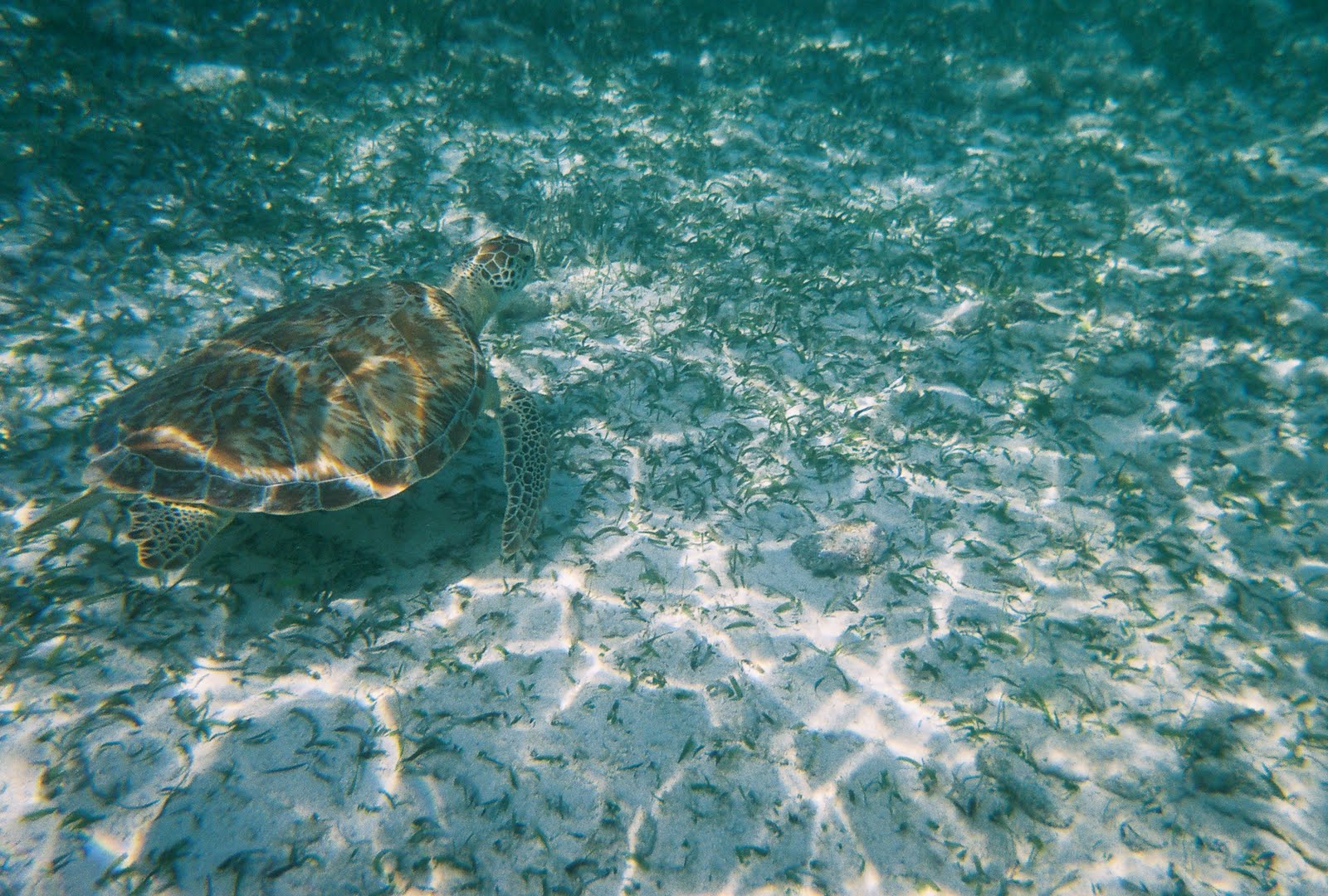
It was a giant gray-green sea turtle. I know water distorts, but it look at least three feet wide across its shell. Its head turned slowly on its thick neck, and with huge eyes, it regarded me flopping around in the water. Something like a patient smile turned its lips up slightly at the corner. Mesmerizingly slowly, its eyelids closed and then opened in a knowing blink. The very presence of this turtle instilled some sort of hope in me and I stopped gasping in air. The turtle stayed right next to me, its huge arms moving in slow motion back and forth in the water. It would turn its patient blink my way as if to say, “Try it this way.” I did. I regulated my breathing, put my head face down in the water, and slowly waved my arms back and forth at my side instead of the pell-mell, over head grasping at water that had worn me out. I turned to check my progress with the turtle that nodded ever so slightly and continued by my side. Instead of flapping my legs like a crazy woman, I used the flippers as they were designed to be used, in a slow, regular motion that propelled me through the water with much less effort.

We traveled on, side by side, turning our heads and nodding at each other. At one point I risked a smile and took in some ocean water. I decided I’d just smile with my eyes from that point on. I raised my head to see how far we’d come. The beach was in sight. It was reachable. I felt a rush of energy as I put my face back down in the water and discovered that in just a few moments my feet would reach bottom. My heart pounded, but this time in joy and gratitude. I righted myself on my flippers and turned to thank the turtle. It raised its head from the water, gave one final blink, dove under the water and swam off to the left.

From that day forward, I have acknowledged turtle as another of my wonderful spirit guides.

*Reference: Bennett, Hal Zina Ph.D., Spirit Guides, Tenacity Press, CA, 1997, p. 65 Meeting Your Spirit Guide

Saturday, March 20, 2010

Belize Adventure


Vacations are great inspiration for potential stories. For instance, I just got back from Belize with friends Trudy, Joan, and sister Sus. We flew into the International Airport, walked into a reception area with a Customs desk on the left. Through my jet-lagged eyes, I saw a huge pedestal behind which three or four mean-looking, suspicious men and women glared down at us weary, scraggly travelers, just daring us to try and smuggle a fruit-fly laden apple into their country. They were heavily uniformed—I have a trauma-based aversion to anything uniformed (even head waiters creep me out) from the 60ies, and possibly armed. I told you I was fatigued—and sleep-deprived. Somehow, we cleared Passport inspection with only a question or two about our intent.

Ahead, we aim for the luggage carousel. By implicit agreement, we all keep a look out for each other, two of us never having traveled abroad. Three of us wander to the right of the carousel, Joan wanders to the left. Slowly, the bags are placed on the conveyer. Trudy and Sus pull theirs off and are waiting behind, out of the way. I spot my little bag with the bright red ribbon and hoist it up off the carousel. Smiling with the success of my trip so far, I turn to Trudy and Sus. We glance around for Joan. Hmm, in such a small space (a one room lobby), where could she possibly be? Oh, yeah, the bathrooms. Joan? Joan? No Joan. Okay, don’t panic. There’s the duty free store just across the lobby. Sure, that’s where she is. No Joan.

How many headlines have you seen on the evening news about women or children who disappear without a trace in foreign countries? All those come roaring back to me in my head. Breathe. Don’t jump to conclusions. Okay. OH MY GOD, SHE’S BEEN KIDNAPPED! My head swivels back and forth, up and down (I knew she wasn’t really on the ceiling—it was just reflex). We speak to someone in the office. They have no idea, figure she’s cleared Customs and has probably gone on outside. No, she wouldn’t do that, we mumble between us.

There were forms to fill out before we could even go out and see if she was on the other side. Once out, we can’t return to the lobby. How will we communicate with each other? Group decision: we’ll go out, hope she is returned by the kidnappers and figures out we’re not in the lobby. Perhaps she’ll find her way through customs and meet us outside. Okay—that’s the plan.

We fill out our forms, have them stamped, and are herded out the door to await our connecting plane. I cast a furtive glance behind me as I leave the lobby. Stepping through the door I see Joan to my right, looking bored, tired, wondering where the heck we’ve been. She had grabbed her bags as soon as they’d hit the carousel and in her expedient little way headed on through Customs to wait for us on the other side.

Relief pours out of my body like sweat from the change of climate. Kind of an anticlimactic ending for a potentially great kidnap/ransom mystery, but I’ll trade that any day for the safety of my good friend.

For information about the Belize Jungle Dome Resort and Adventure Tours: www.belizejungledome.com
Check it out; you won’t be disappointed.

Saturday, February 6, 2010

Color Pallet – Travel Musings


Neck stiff and travel weary, I turn my head and look past the haggard, sleep-deprived sojourner next to me, beyond my reflection in the Greyhound window, into the early morning sky.

Black clouds stretch like raven wings along the horizon, back lighted by steel gray as the sun waits off stage to make her entrance.

Miles down the road at sunrise, the moist, peach California sky is the same color that lines the inner folds of a seashell I found on a beach in Coral Gables, Florida; the clouds--shifting wisps of mauve—a similar hue as the Colorado mountains at sunset. At daybreak, midsummer hills imitate the variegated yellow, gold, and brown tassels topping fields of corn from my Iowa childhood.

We pass a County fair; the double Ferris wheel stands in bas-relief like a giant infinity symbol.

Beyond the Golden Gate Bridge, shimmering fog swaddles San Francisco. It is slow to lift and gives only a hint—a mere suggestion—that a city lies within.

The stippled waters of the Bay spread like cellulite-laden thighs.

At the edge of Golden Gate Park, a body lies prone in the underbrush of eucalyptus and cypress; one less nameless, faceless, homeless mark of urban blight for the equestrian patrol to roust.

Gray pigeons on the rooftop of a cheap motel smirk down at the pink neon sign flashing vacancy in a filmy window. Irony is not lost on them.